Introduction
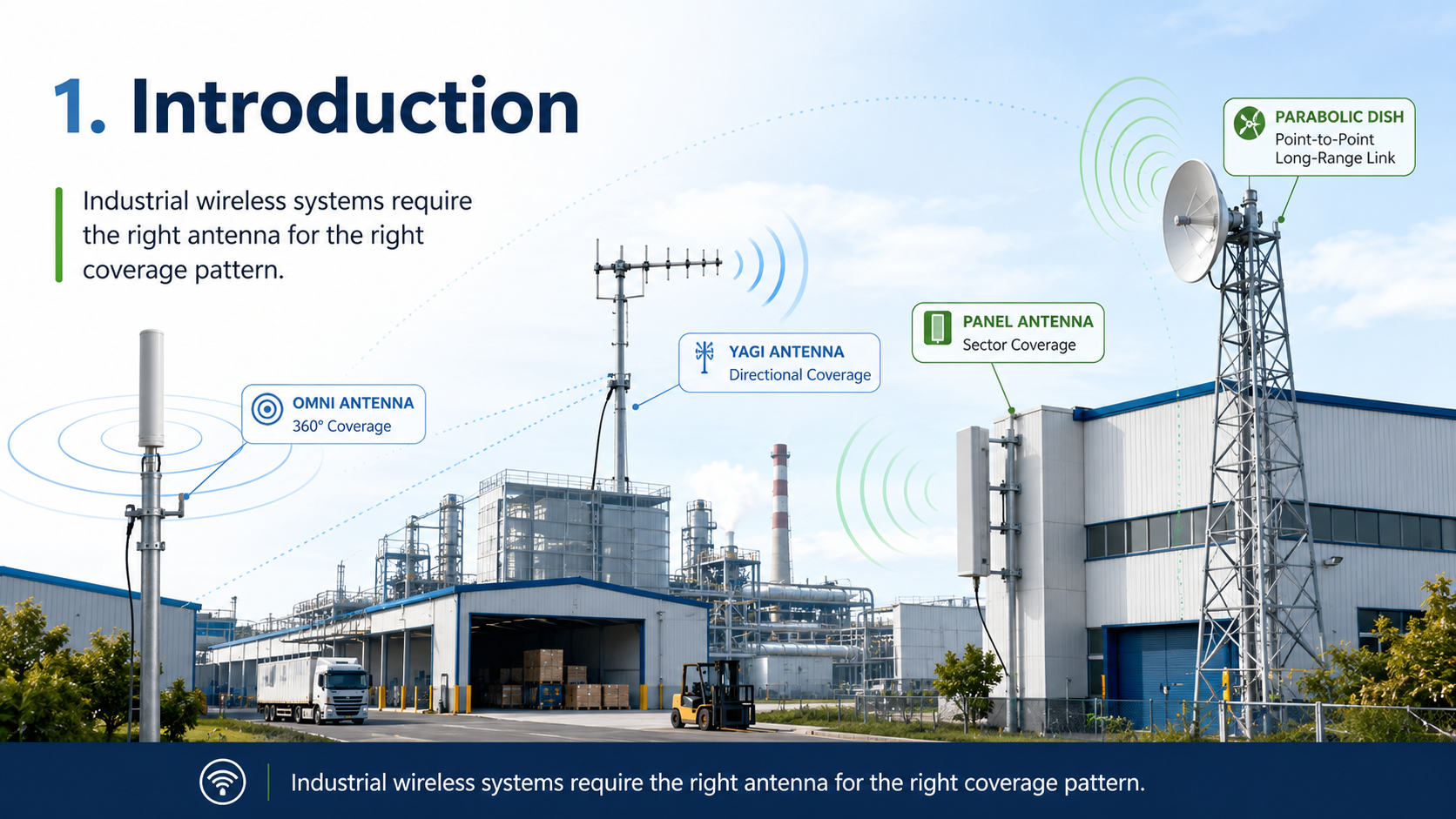
Reliable wireless communication is an important part of modern industrial systems. Factories, warehouses, remote sites, SCADA networks, telemetry systems, CCTV links, and IoT sensor networks often depend on antennas to move data across different distances and environments.
Choosing the wrong antenna can cause weak signals, unstable connections, packet loss, and poor network coverage. Choosing the right antenna helps improve signal strength, coverage direction, link stability, and overall system performance.
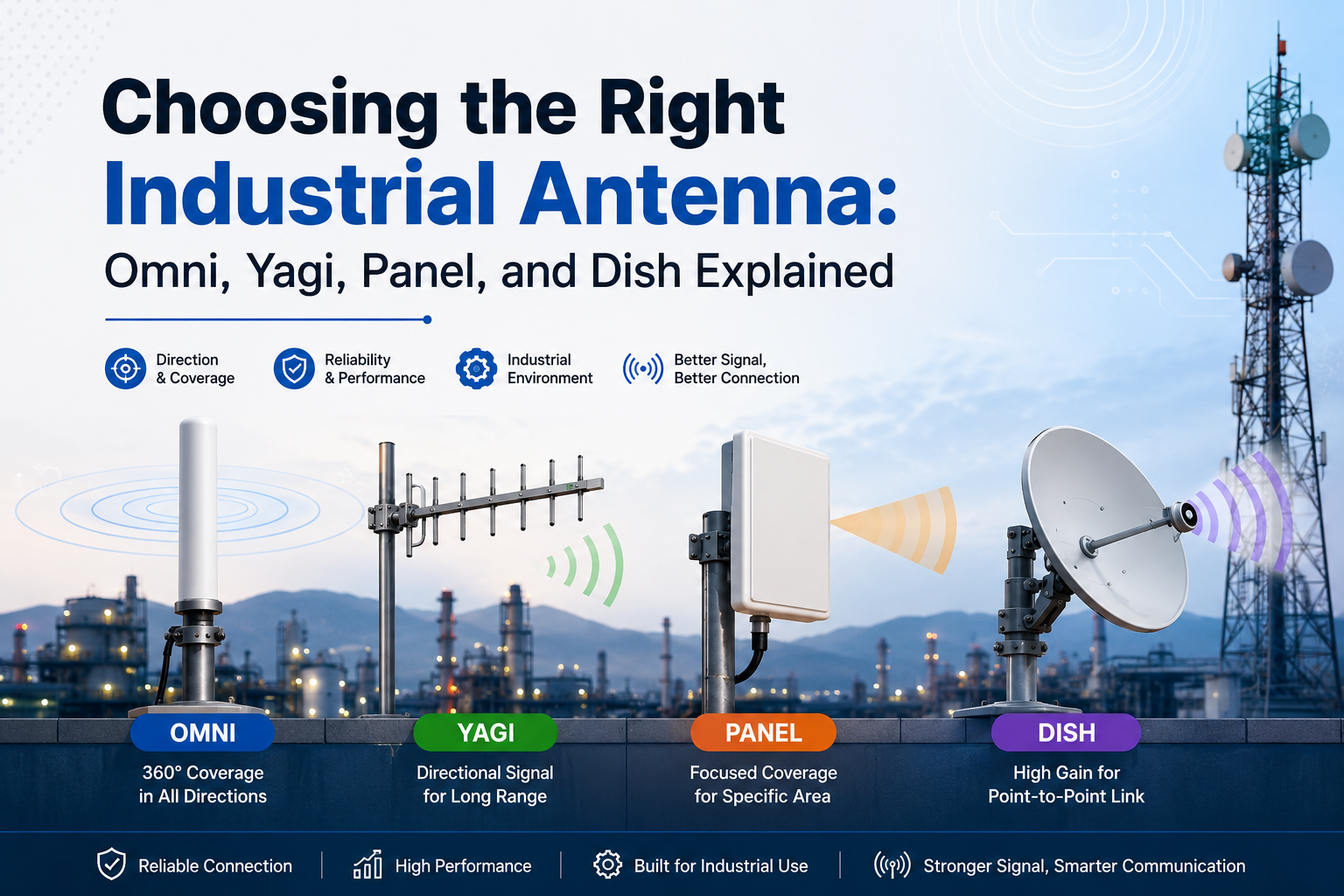
This article explains four antenna types that are commonly used in industrial communication: omni-directional, Yagi, panel, and parabolic dish antennas.
Antenna Basics
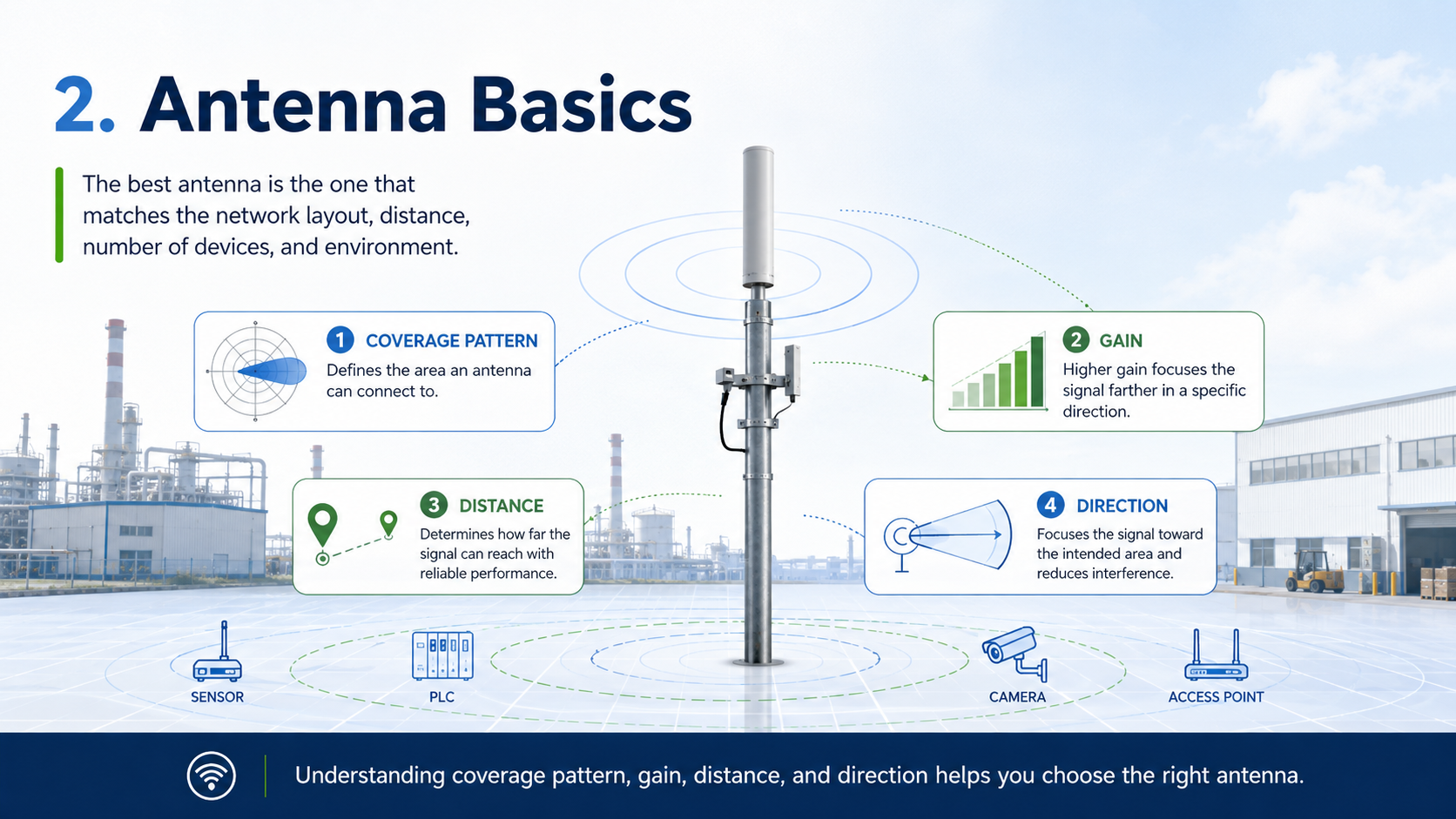
An antenna is not just a device that sends or receives signals. It also shapes where the signal goes. Some antennas spread signal in every direction, while others focus signal toward one specific target.
The most important factors to understand are coverage pattern, gain, distance, and installation direction. A wider coverage pattern is useful for serving many devices in one area. A narrower pattern is better when the signal must travel farther and stay focused.
In industrial communication, the best antenna is not always the strongest one. The best antenna is the one that matches the network layout, distance, number of devices, and physical environment.
Omni Antenna
An omni-directional antenna radiates signal in all horizontal directions, usually around 360 degrees. This makes it suitable for covering a wide area where devices are located around the antenna.
This type is commonly used when multiple devices need to connect from different directions. For example, it can be installed in the center of a warehouse, factory floor, monitoring area, or outdoor industrial yard.
The main advantage of an omni antenna is broad coverage. However, because the signal spreads in many directions, it is usually not the best choice for very long-distance point-to-point communication.
Yagi Antenna
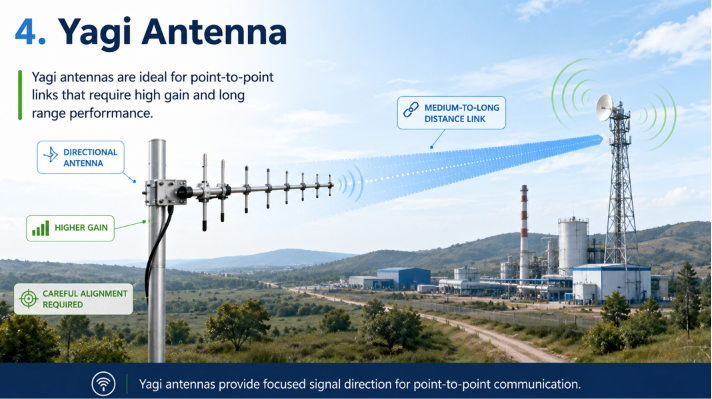
A Yagi antenna is a directional antenna that focuses signal toward one specific direction. It usually has higher gain than an omni antenna and is useful when two points need to communicate across a medium or long distance.
Because the signal is focused, a Yagi antenna can improve link quality when the target location is known. It is often used for telemetry, radio links, remote sensor communication, and point-to-point wireless connections.
The installation must be aligned carefully. If the antenna is not pointed correctly, the signal can become weak even when the antenna has high gain.
Panel Antenna
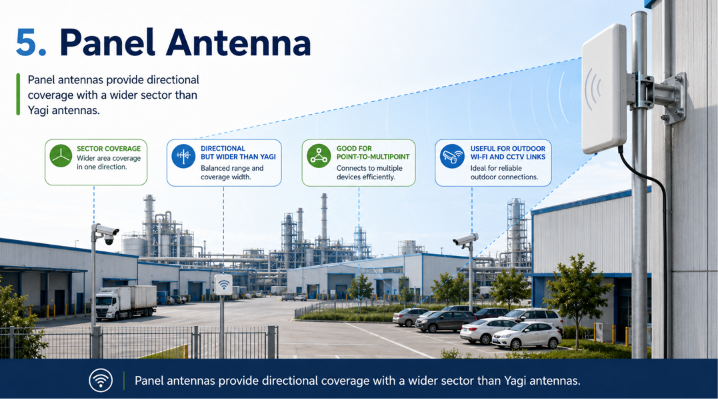
A panel antenna is also directional, but it usually has a wider beam than a Yagi antenna. This makes it useful when the system needs to cover a specific sector instead of only one narrow direction.
Panel antennas are often used in outdoor Wi-Fi, wireless CCTV, industrial access points, and point-to-multipoint networks. They can serve several devices within a controlled coverage area while still keeping the signal more focused than an omni antenna.
This antenna type is a good choice when devices are located in front of the antenna within a certain angle, such as across a yard, production zone, parking area, or building sector.
Dish Antenna
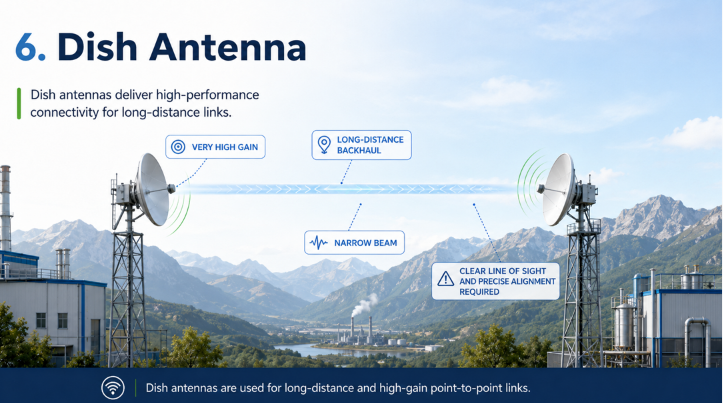
A parabolic dish antenna is designed for highly focused, long-distance communication. It has very high gain and a narrow beam, making it suitable for backbone links, microwave links, backhaul connections, and communication between industrial sites.
Because the beam is narrow, dish antennas require accurate alignment. Even a small installation error can reduce link performance. They also need a clear line of sight between both endpoints.
Dish antennas are powerful, but they are not suitable for covering many nearby devices. They are best used when the goal is to connect one site to another over a long distance with a stable and focused wireless link.
Comparison Guide
Use an omni-directional antenna when the goal is to cover a wide area with many devices around the antenna. This is suitable for general wireless coverage, local sensor networks, and industrial access points.
Use a Yagi antenna when the connection must be directed toward one specific remote point. This is suitable for telemetry, remote monitoring, and medium-to-long distance radio links.
Use a panel antenna when the system needs to cover a specific sector with several devices inside that area. This is useful for outdoor Wi-Fi, CCTV wireless links, and point-to-multipoint communication.
Use a parabolic dish antenna when the system requires a long-distance backbone or inter-site connection. This is the right choice for focused high-gain links where both endpoints are fixed and aligned.
Selection Factors
Before selecting an antenna, check the communication distance, number of connected devices, required coverage direction, available mounting position, and line-of-sight condition.
Also consider environmental factors such as buildings, metal structures, machines, trees, walls, and electromagnetic noise. Industrial environments can create reflections and interference, so antenna placement is just as important as antenna type.
A good wireless design usually starts with a site survey. This helps identify the best installation point, antenna height, direction, and expected signal quality before the system is deployed permanently.
Common Mistakes
One common mistake is using an omni antenna for every situation. While omni antennas are convenient, they are not always the best option for long-distance or focused communication.
Another mistake is choosing a high-gain antenna without understanding its beam pattern. Higher gain often means narrower coverage. If the antenna is not aligned correctly, the result can be worse than using a lower-gain antenna.
Poor mounting location is also a frequent problem. Antennas installed too low, too close to metal objects, or blocked by buildings may produce unstable links even when the equipment specification looks good.
Conclusion
Industrial wireless communication becomes more reliable when the antenna matches the network design. Omni antennas are best for wide-area coverage, Yagi antennas are best for focused point-to-point links, panel antennas are best for sector coverage, and parabolic dish antennas are best for long-distance backhaul.
The right antenna can improve signal stability, reduce communication errors, increase operational efficiency, and support better industrial productivity. Instead of choosing based only on gain, choose based on coverage pattern, distance, direction, and real installation conditions.